GET A 15% OFF COUPON CODE FOR MY SHOP WHEN YOU SUBSCRIBE!

Personification Example Sentence Starters

Published August 2021 · Updated October 2026

Have you ever watched a class light up when the toaster “jumps” or the moon “smiles” in a picture book? That’s personification, and it’s one of the most fun types of figurative language to teach!

Here’s the thing, though: figurative language comes with a LOT of vocabulary, and kids mix it up easily. The fix is examples about things they already love. Once kids get it, they’re smiling, laughing, and writing their own.

Below you’ll find a kid-friendly definition, a list of personification words, 34 personification examples in a sentence (sorted by theme), a practice set with answers, and easy ways to teach it in 2nd-6th grade or at home.

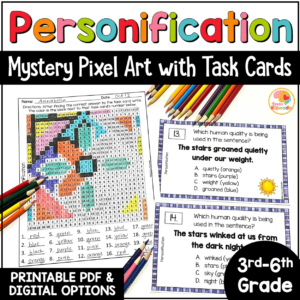
Personification mystery pixel art with task cards for 3rd-6th grade, printable PDF and digital options

What Is Personification?

Personification gives human actions, feelings, or qualities to something that isn’t human, like an object, an animal, or an idea. “The flowers snuggled in the sunlight” is personification, because flowers can’t really snuggle.

Here’s a tip for kids: look for the word person hiding inside personification. If something that isn’t a person is doing something only a person can do, you’ve found it!

When kids spot personification, they can ask three questions:

  1. What is being personified?
  2. Which human action or feeling is it given?
  3. What does the sentence really mean?

Personification Words and Examples

These human action words show up in personification all the time.

Personification wordExample sentence
smiledThe sun smiled down on the playground.
dancedThe leaves danced across the sidewalk.
whisperedThe wind whispered through the trees.
winkedThe stars winked at us from the night sky.
groanedThe old stairs groaned under our feet.
huggedThe warm blanket hugged me all night.
sangThe teakettle sang on the stove.
racedThe pencil raced across the page.
beggedThe cookies begged me to eat just one more.
waitedThe empty swing waited patiently for someone to play.
complainedMy stomach complained loudly before lunch.
yawnedThe dark cave yawned open in front of the hikers.
Personification anchor chart: "The flowers snuggled in the sunlight," showing what is personified and what it means

Why Kids Love Personification

Personification works for just about any topic, so every student can find examples about something they love, from gaming to unicorns. Kids who are interested pay attention, and kids who pay attention learn more deeply. Once they’re comfortable, they can write their own sentences. (Fair warning: they get SILLY.)

Personification Examples in a Sentence

Every class has kids with all different interests. Pick the theme that fits yours!

Sports-Themed Personification Examples

  • Time sure runs quickly when we’re on the field.
  • The ball jumped out of her hands.
  • The volleyball screamed as it soared over the net.
  • The basketball hoop swallowed the winning shot.
  • The scoreboard laughed at our team’s tiny score.

Animal-Themed Personification Examples

  • The cat danced around the toy mouse before pouncing on it.
  • The owl stayed up all night reading her favorite book.
  • The squirrels gossiped about who had the biggest pile of acorns.
  • The dog rolled his eyes when I said it was bath time.
  • The goldfish sighed and waited for someone to clean her bowl.

Weather-Themed Personification Examples

  • The wind gently kissed my cheek as I walked.
  • The moon played hide-and-seek with the clouds.
  • The angry thunder shouted at the town all night.
  • The snow tucked the garden in for the winter.
  • The rain tapped on my window, asking to come inside.

Flower and Nature Personification Examples

  • The flowers snuggled in the sunlight.
  • The sunflowers turned their faces toward the sun.
  • The roses blushed in the garden.
  • The daisies nodded their heads in the breeze.
  • The old oak tree stretched its arms toward the sky.
  • The tired tulips drooped after the long, hot day.

Unicorn-Themed Personification Examples

  • The unicorn waved to the other animals.
  • The unicorns play tag for at least two hours a day.
  • The rainbow smiled at the unicorn as she galloped by.
  • The clouds giggled as the unicorn bounced across them.

Superhero-Themed Personification Examples

  • When Super Sam took off, thousands of leaves danced on the ground.
  • The stars winked at Captain Comet as he saved the day again.
  • The city skyline cheered when the hero landed.
  • The villain’s robot cried when its battery died.

School-Themed Personification Examples

  • The pencil raced across the page as I finished my writing assignment.
  • The old stairs groaned under our weight.
  • My alarm clock yelled at me to get up for school.
  • The bell called everyone in from recess.
  • My homework stared at me from the kitchen table.

Practice: Find the Personification (With Answers)

Read each sentence. What is being personified, and what human action or feeling is it given?

  1. The car coughed and sputtered up the hill.
  2. My backpack sighed when I stuffed in one more book.
  3. The ocean waves waved goodbye as we left the beach.
  4. The flowers danced in the spring breeze.
  5. The lazy river took its time winding through the park.
  6. The computer refused to turn on.

Answer key: 1. the car: coughed and sputtered. 2. the backpack: sighed. 3. the waves: waved goodbye. 4. the flowers: danced. 5. the river: lazy, took its time. 6. the computer: refused.

Two personification task cards: fill in the blank to personify "My old bike" and "The rain puddle"

Easy Ways to Teach Personification

  • Object interviews: Students pick a classroom object (a pencil sharpener, a trash can, or a clock) and write what it would say if it could talk.
  • Picture book hunt: Read aloud and pause whenever an object or animal does something only people do. Picture books are FULL of personification.
  • Draw it: Students pick a personification sentence and draw it exactly as written. A sun wearing sunglasses? Yes, please!
  • Task cards and pixel art: For ready-to-go practice, try the Personification Mystery Pixel Art Color-by-Code Activities or the Personification Task Cards and Activities. Both keep kids engaged with fun, creative examples.
Personification task cards and worksheets for kids with a personification examples anchor chart and colored pencils

Homeschooling? Make it a game on your next walk. Point at something (a mailbox, a tree, or a parked car) and have your kids give it a human action. The sillier, the better!

Personification FAQ

What is personification in simple words?

Giving human actions or feelings to something that isn’t human, like “The sun smiled down on us.”

What are 5 examples of personification?

The wind whispered through the trees. The flowers danced in the breeze. The stars winked at us. My alarm clock yelled at me. The old stairs groaned under our feet.

Can animals be personified?

Yes, when an animal does something only people do, like reading a book or rolling its eyes. A dog barking or sitting by the door isn’t personification, because dogs really do those things.

What’s the difference between personification and a metaphor?

A metaphor says one thing IS another (“The classroom was a zoo”). Personification gives human actions or feelings to something that isn’t human (“The classroom groaned when the bell rang”).

Is personification figurative language?

Yes. It’s one of the most common types, along with similes, metaphors, idioms, hyperbole, and onomatopoeia.

If you ask students at the beginning of the year to explain personification, many will have no idea. By spring, they’ll know the secret is hiding right in the word: person. Give them examples about the things they love, and they’ll be spotting personification in every book they read!

If you don’t want to miss any upcoming lessons, join my email list! You’ll also get FREE Figurative Language Bell Ringers just for blog subscribers.

I also have more figurative language posts you might like: onomatopoeia examples, idiom examples, and simile and metaphor examples.

Kirsten Tulsian
About Kirsten Tulsian
Kirsten Tulsian is an elementary educator and author with nearly 20 years of experience as a teacher and school counselor. She is the creator of Kirsten's Kaboodle and writes reading, writing, grammar, and social-emotional learning resources and workbooks for grades 2-6.
Kirsten Tulsian, founder of Kirsten's Kaboodle

I am Kirsten Tulsian, an elementary educator with nearly 20 years of experience as a teacher and counselor. My passion lies in empowering students to discover their inherent brilliance through the use of engaging, rigorous, and meaningful activities. I look forward to connecting with you!

Latest Posts