Here’s the thing about similes and metaphors: kids can usually tell that SOMETHING is being compared. The tricky part is deciding which one they’re looking at. Sound familiar?
The good news? One quick test works almost every time. Once kids have it, they can sort similes and metaphors all day long.
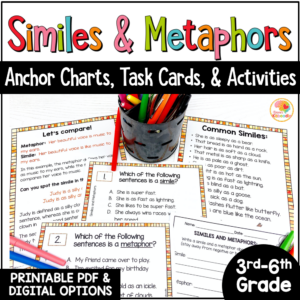
Below you’ll find a simple way to explain the difference, a side-by-side table, 16 simile and metaphor examples for kids (sorted by theme), a practice set with answers, and the activities I’d reach for. It all works in a 2nd-6th grade classroom or at home with your homeschoolers. Two of my favorite resources for this skill are the Simile and Metaphor Color by Number Pixel Art Activity and the Simile and Metaphor Activities & Worksheets.
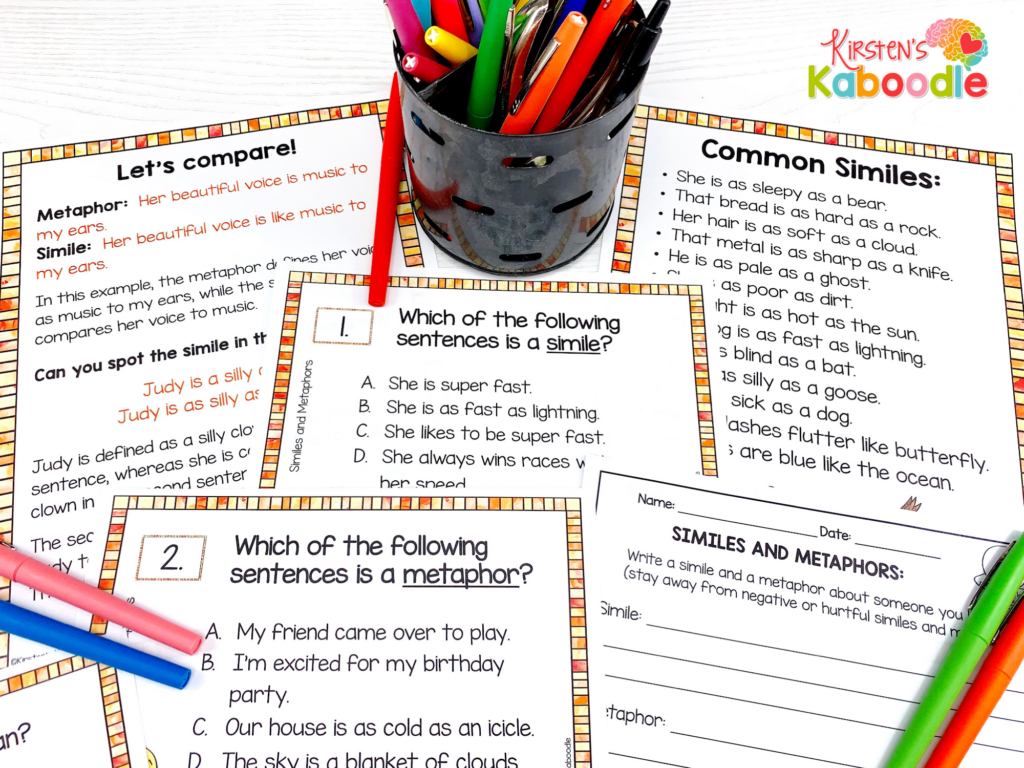
A simile compares two different things using the words like or as. A metaphor compares two different things by saying one thing IS the other, without like or as.
The quick test: look for like or as. If the comparison uses one of them, it’s a simile. If it doesn’t, it’s a metaphor.
Both sentences mean Luca is REALLY tired. The simile says he’s like a bear. The metaphor says he is one.
One heads-up for kids: not every like makes a simile. “I like pizza” isn’t comparing anything (it’s just true 😆). A simile has to compare two different things.
| Simile | Metaphor | |
|---|---|---|
| What it does | Compares two different things | Compares two different things |
| Signal words | Uses like or as | No like or as |
| How it sounds | One thing is LIKE another | One thing IS another |
| Example | The snow was like a white blanket. | The snow was a white blanket. |
| Example | Her eyes sparkled like stars. | Her eyes were sparkling stars. |
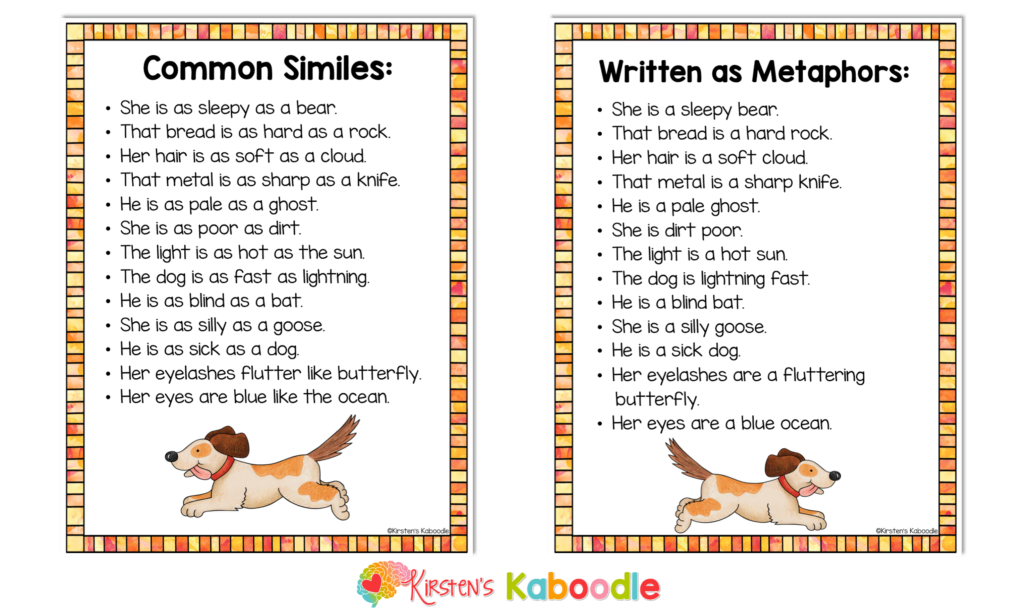
Kids are more engaged when the examples are about things they love. Here’s every example as a matching pair, so kids can see the same idea written both ways. Pick the theme that fits your class!
| Theme | Simile | Metaphor |
|---|---|---|
| Sports | The pitcher threw the ball as fast as lightning. | The pitcher’s arm was a cannon. |
| Sports | She ran to first base like a cheetah. | She was a cheetah on the bases. |
| Sports | The crowd roared like a lion. | The crowd was a roaring lion. |
| Fairy tales | Rapunzel’s hair was as soft as a cloud. | Rapunzel’s hair was a soft cloud. |
| Fairy tales | Cinderella’s slippers were as shiny as the sun. | Cinderella’s slippers were two tiny suns. |
| Fairy tales | The calm lake was like a mirror. | The calm lake was a mirror. |
| Animals | She was as brave as a lion on the roller coaster. | She was a lion on the roller coaster. |
| Animals | My mom was as busy as a bee. | My mom was a busy bee. |
| Animals | The classroom was as wild as a zoo. | The classroom was a zoo. |
| Animals | The school computers are as old as dinosaurs. | The school computers are old dinosaurs. |
| Food | The pillow was as soft as a marshmallow. | The pillow was a marshmallow. |
| Food | His kind words were as sweet as honey. | His kind words were honey. |
| Food | The kids popped out of their seats like popcorn. | The kids were popcorn, popping out of their seats. |
| Unicorns and mermaids | The unicorn was as pink and fluffy as cotton candy. | The unicorn was a cloud of pink cotton candy. |
| Unicorns and mermaids | The mermaid’s tail shimmered like a rainbow. | The mermaid’s tail was a rainbow after a storm. |
| School | My backpack is as heavy as a bag of bricks. | My backpack is a bag of bricks. |
Read each sentence. Is it a simile or a metaphor? What two things are being compared?
Answer key: 1. metaphor (clouds and cotton balls). 2. simile (dog and lamb). 3. simile (cheeks and peaches). 4. metaphor (brain and sponge). 5. simile (lake and glass). 6. metaphor (playground and oven).
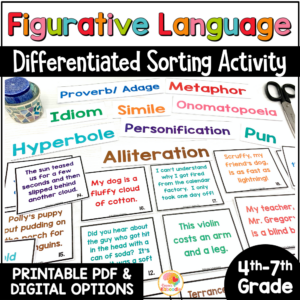
When kids need more practice, my Simile and Metaphor Activities & Worksheets has you covered: worksheets, 36 task cards, and a variety of activities. Everything works on paper or in Google Slides, and the task cards also come in Google Forms. Use them whole-group, in literacy centers, or in small groups.
The task cards ask for different things as students go, so kids can’t just coast through the same question 36 times. They really have to decide which is which!
For a calmer, colorful way to practice, try the Simile and Metaphor Color by Number Pixel Art Activity, with printable and digital options.
Homeschooling? Turn it into a car game. One person says a simile (“The car is as slow as a turtle”), and the next person turns it into a metaphor (“The car is a turtle”).
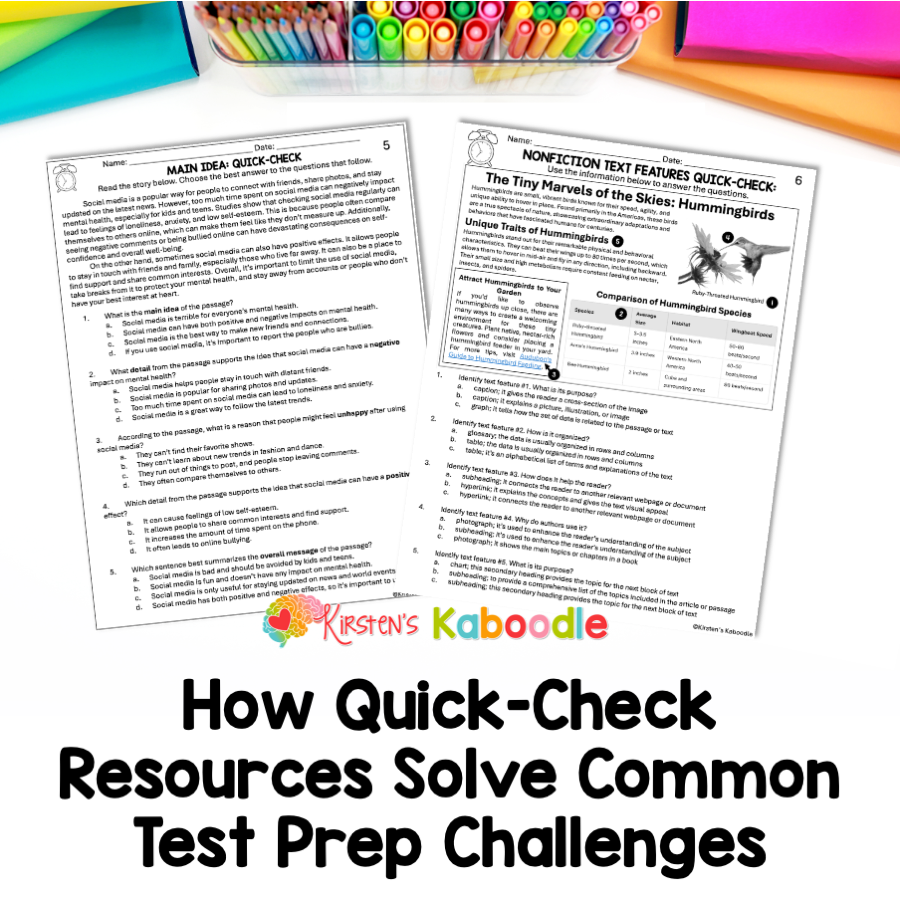
If you’re looking for figurative language quick-check baseline assessments or test-prep materials, click the image below.
A comparison of two different things using like or as, such as “as busy as a bee.”
A comparison that says one thing IS another, such as “The classroom was a zoo.”
Start with the like-or-as test. Then have kids rewrite similes as metaphors (and back again). Sorting activities and task cards help it stick.
Not always! “Walking on eggshells” sounds like a metaphor, but it’s an idiom: a set phrase that means being very careful not to upset someone. Kids learn idioms as whole phrases. Here are more idiom examples for kids.
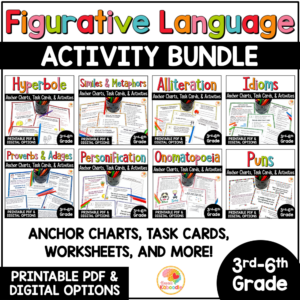
Yes. They’re two of the most common types of figurative language, along with idioms, personification, hyperbole, and onomatopoeia.
Telling similes and metaphors apart takes time and practice. With examples kids care about and activities that get them thinking, they’ll be spotting comparisons in every book they read!
Want to save big on these figurative language activities and so many more? Check out how you could join my membership today!
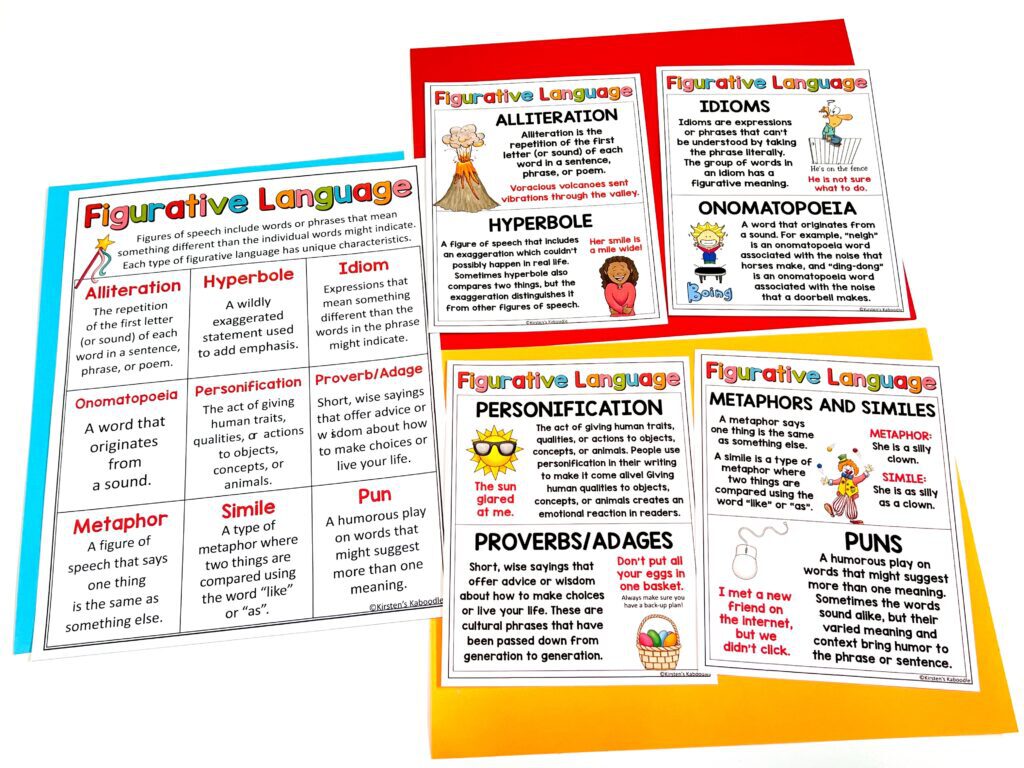
If you need more help teaching onomatopoeia, personification, or idioms, I GOT YOU!
Join my email list so you never miss a new lesson, and grab two weeks of FREE figurative language bell ringers that include similes and metaphors HERE.